Diamond Decks: Roguelike Road Trip
An addictive deckbuilding baseball roguelike where psychological pitch reading meets compounding score multipliers. Combining Balatro's instant pick-up-and-play math accessibility, Slay the Spire 2's deep relic-card synergies, Magic: The Gathering Arena's tactile card feel, and Persona 5 Royal's dynamic cinematic visual identity.
Design Standard: Balatro / Slay the Spire 2 / MTG Arena / Persona 5 Royal · Simulation Verified via proto-zero5
Executive Pitch: Diamond Decks turns baseball's central duel into an electrifying tactical roguelike.
Both sides commit two cards face down, four cards flip simultaneously, and players chain combination matches into escalating red dice rolls.
Scores explode through the (X [Flight] + Y [Legs]) × Rally multiplier loop, driven by 4 batting lineup characters, 12 equipment relics,
and an expansive 27-Card Progressive Unlock Matrix (3 pitch families × 9 strike-zone quadrants).
1 · Market Positioning & Design Pillars
The roguelike deckbuilder genre has proven immense commercial vitality with breakout hits like Balatro ($30M+ grossing, 3M+ copies sold) and Slay the Spire. Diamond Decks captures this massive market by merging casual-friendly spatial deduction with escalating multiplier hype and sports fantasy management.
1. Balatro Simplicity & Hype
Instant 30-second loop. No complex text paragraphs to read during play — simple visual matching (quadrants & colours) triggers escalating score explosions with satisfying visual meters.
2. Slay the Spire 2 Synergy Depth
Deep build variety. 4 Lineup Characters, 12 Equipment Relics, and 6 Bullpen Arms unlock distinct archetypes (Power Slugger, Small-Ball Speed, Deduction Intel, Bullpen Defense).
3. MTG Arena & Persona 5 Feel
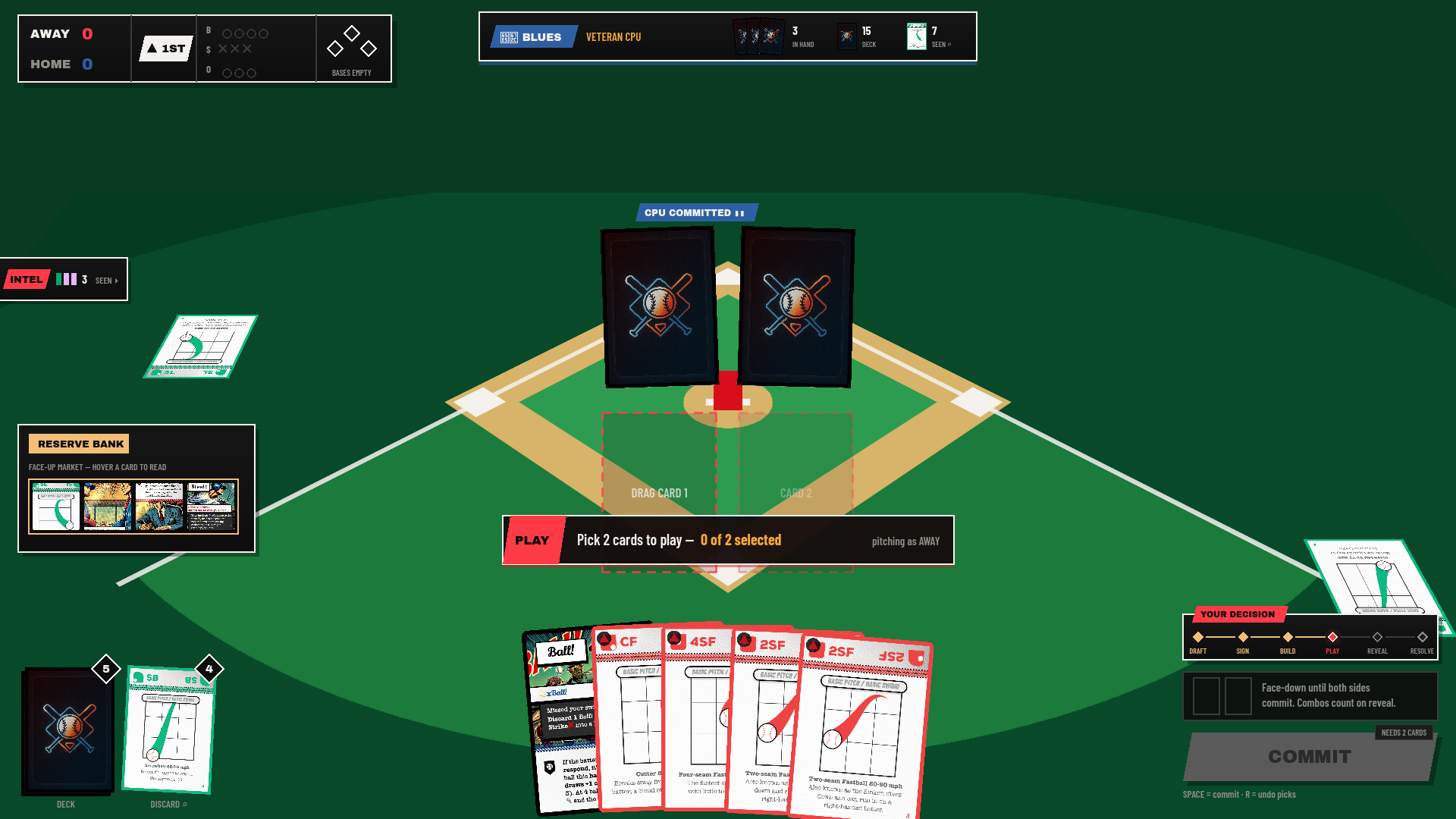
Tactile weight and impact. Shimmering foil card shaders, heavy 3D dice slams with trauma screen shake, dynamic 70mm camera choreography, and 32×32 pixel art field sprites.
2 · The 30-Second Core Gameplay Loop
3 · Step-by-Step Player Onboarding & First Run Walkthrough
To visualize exactly how a session plays from minute one to stage victory, step through the 8-stage interactive run walkthrough below:
4 · The Balatro-Style Multiplier Formula
Just like Balatro's Chips × Mult, Diamond Decks drives all score progression through an intuitive, compounding formula that rewards combo mastery and basepath sequencing:
SCORE = ( X [Ball Flight Distance] + Y [Basepath Legs] ) × RALLY [Multiplier]

where:
  X (Flight) = (25m × Combos) + (15m × count of "+" red die faces)
               *On HOMERUN: X = Fence Distance (105m + 25m × Act)
  Y (Legs)   = 27.4m × Total Bases Advanced across all runners
  RALLY      = 1 + Hit Streak + Character Rally Bonuses + Relic Modifiers
               *Outs divide active streak by 2 (D44) rather than resetting to 1!
Interactive Multiplier Sandbox
Experiment with combinations, dice outcomes, and rally multipliers below to observe the real-time scoring engine in action:
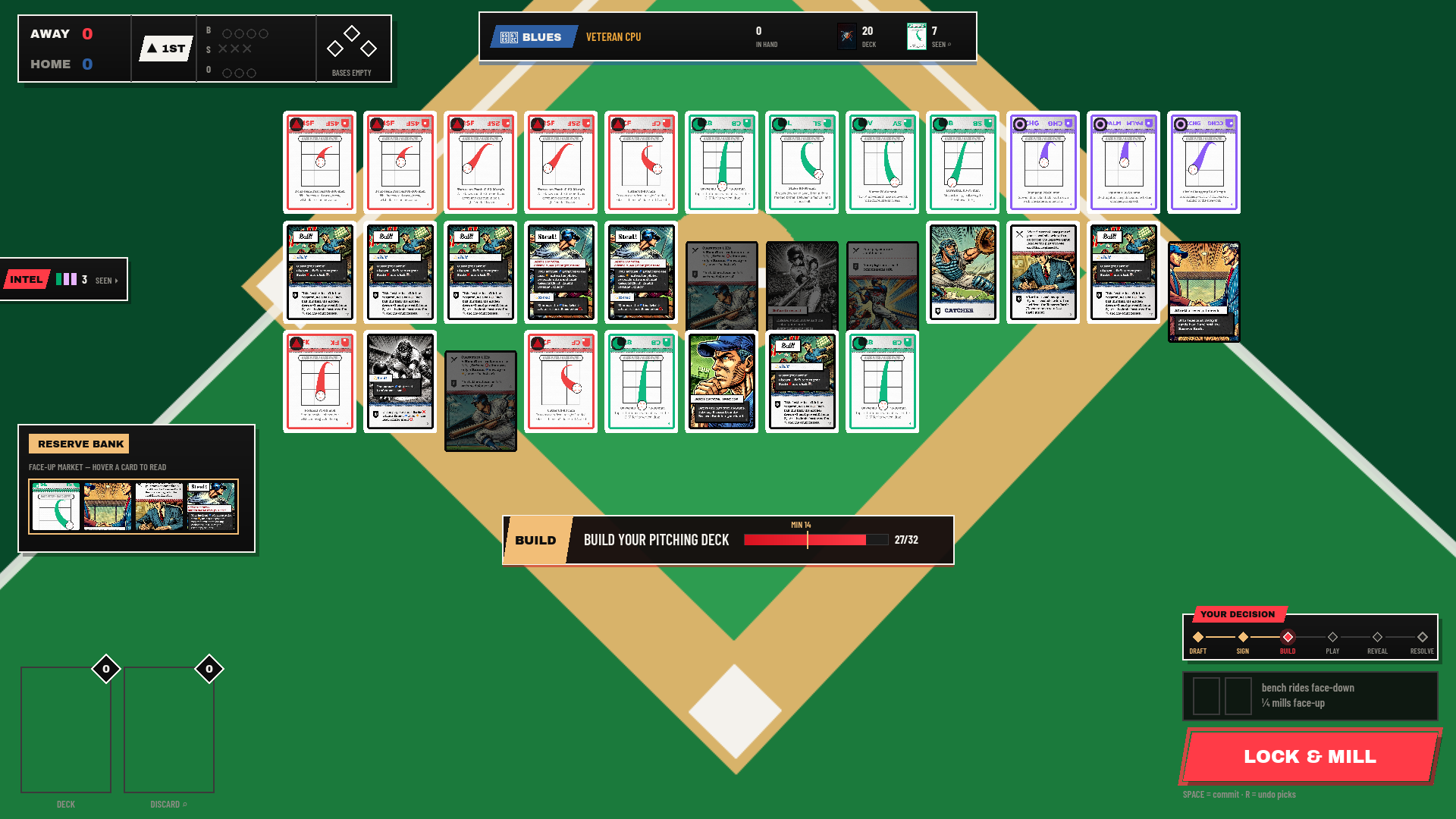
5 · Progressive 27-Card Pitch Unlock Matrix (3×9)
While the tabletop boardgame is fixed to 12 basic pitches across 5 core quadrants, the Roguelike Mode unlocks a complete 27-Card Repertoire Matrix (3 pitch families × 9 strike-zone quadrants). As players progress through Acts and complete run bounties, new quadrant and velocity pairings unlock into the card pool, dramatically expanding deck customization and AI reading depth.
Full 27-Card Unlock Registry
| Family | Quad | Code | Pitch Name | Velocity | Unlock Stage | Mechanical Profile & Flavour |
|---|
6 · Slay the Spire 2 Synergy Archetypes
Build identity in Diamond Decks is forged through the interaction of Lineup Characters (which rotate through the batting order at-bat by at-bat) and Equipment Relics (passive run-wide modifiers):
🔥 Velocity Power / Home Run Build
Core Strategy: Maximize Fastball matches and Red Dice generation to trigger crushing Home Runs that skip defense stops entirely.
- Key Characters: Slugger (+30m on HR), Cleanup (+2 Red Dice on 3+ Combos).
- Key Relics: Corked Bat (+1 Red Die), Radar Gun (Fastballs +20m), Pine Tar Rag (Reroll 1 Red Die).
- Deck Core: 4SF, HH, CT, FS (High-velocity Fastball saturation).
⚡ Small-Ball / Basepath Velocity Build
Core Strategy: Exploit high base advance counts (Y-term), aggressive Steals, and rapid Rally scaling over multiple hits.
- Key Characters: Leadoff (+2 Rally on 1st AB), Contact (+1 Extra Base on all hits).
- Key Relics: Spikes of Hermes (+1 Base on Steals), Green Light (Steal without interrupt), Chalk Lines (+15m per advance).
- Deck Core: Steal!, Bunt, 2SF, PALM, CHG.
🧠 Master Scout / Precision Deduction Build
Core Strategy: Strip the CPU of hidden information, allowing guaranteed 4–5 combo reads and consistent high-multiplier clears.
- Key Characters: Patient Hitter (Reveals 1 CPU card before commit), Maestro (+1 Combo bonus on Breaking pitches).
- Key Relics: Binoculars (Exposes CPU quadrant family), Scouting Report (CPU deck revealed in HUD).
- Deck Core: Balanced 3-family deck with high quadrant coverage.
7 · Empirical Monte Carlo Statistical Balance Proof
To ensure pristine competitive balance and eliminate frustrating RNG spikes, the entire Roguelike balance curve was validated through 900 headless simulation runs across multiple multiplier configurations (tests/sim_rogue.gd):
| Multiplier Mode (n = 300) | Avg Stages | Avg Score | Mound Trips | Mound Survival | Plays / Act 1 | Plays / Act 2 | Curve Verdict |
|---|---|---|---|---|---|---|---|
| Rally ÷2 (D44 Shipped) | 3.55 | 6,709 pts | 4.04 | 75.2% | 9.2 plays | 18.6 plays | Pristine Flow: +7.9% stage clearance over legacy; target curve holds within ±10%. |
| Rally ÷3 (Ascension 3) | 3.45 | 6,737 pts | 4.52 | 77.9% | 9.7 plays | 21.0 plays | Challenge Tier: Higher attrition pressure; requires tighter deck allocation. |
| Legacy Z (v6 Reset) | 3.29 | 6,109 pts | 4.24 | 76.4% | 9.9 plays | 22.5 plays | Punishing Baseline: Full streak reset on out caused severe late-act drag. |
Empirical Simulation Findings (from tests/sim_rogue.gd):
- Score-to-Target Progression Ratio: Act 1 clears at
1.46×target (generous safety margin), tightening progressively to1.24×in Act 2,1.12×in Act 3, and1.06×in Act 4. This creates a textbook difficulty funnel. - Streak Halving (D44) Efficiency: Reduces required plays per stage in Act 1 from 9.9 down to 9.2, and in Act 2 from 22.5 down to 18.6, maintaining momentum while ensuring high tension.
- Mound Attrition Predictability: 75.2% of mound appearances are survived, allowing players to treat the bullpen as an active strategic health pool rather than an instant loss condition.
8 · Visual Staging: Persona 5 + 32×32 Pixel Art + 3D Camera
The visual design blends high-fashion comic-book graphic design with nostalgic arcade pixel art and cinematic 3D table depth:
Persona 5 / 3 Reload HUD
High-contrast skewed slabs, hard offset drop shadows, Archivo Black uppercase headers, and comic-style impact callouts (HIT!, HOMERUN!, STRIKE THREE!).
32×32 Pixel Art Field Sprites
Handcrafted pixel animations directly on the field: animated runner meeples sliding into bases, pitcher leg kicks and ball trails, batter crack-of-the-bat swings, and umpire strikeout gestures.
70mm Cinematic Camera Rig
7 procedural poses with continuous handheld Lissajous sway, Trauma² screen shake on hits, and dynamic camera zoom punches tracking dramatic walk-off plays.
Interface & Table Production Visuals
9 · Production Roadmap & Commercial Milestones
| Phase | Timeline | Deliverables & Milestones |
|---|---|---|
| Milestone 1: Alpha | Month 1–2 | Complete 27-card unlock matrix implementation in GDScript, 32×32 pixel art meeple animations on 3D field, Balatro score multiplier HUD integration. |
| Milestone 2: Beta | Month 3–4 | Full 3-Act Road Trip campaign map, 12 equipment relics, 15 lineup characters, steam deck optimization, full gamepad focus path. |
| Early Access Launch | Month 5 | Public Steam release with initial 3 Acts, daily seeded runs, global leaderboards, and community feedback telemetry. |
| 1.0 Gold Release | Month 8 | Full release on Steam & Nintendo Switch, expanded Act 4 Endgame Boss, full soundtrack release, localization into 8 languages. |